Housing isn’t just shelter. For children and families, it’s the starting line for a healthy, stable, and opportunity-rich life. Our model, rooted in resident-led transformation, prioritizes stable, mixed-income housing as the foundation for holistic neighborhood change.
Stable Housing Directly Impacts Children’s Futures
The evidence is clear: housing stability has a profound effect on youth success. From positive academic outcomes to emotional development and long-term opportunity, where a child sleeps at night shapes the trajectory of their life. A lack of stable housing often means a child is changing schools frequently, compounding learning loss. A review by the Urban Institute shows that children who face housing instability (including frequent moves, eviction risk, and homelessness) have higher rates of chronic absenteeism, lower test scores, and more grade repetition than peers in stable housing. One study comparing families in stable (homeownership) vs. homelessness-affected households found students in stable homes missed 9.4 days of school on average vs. 17.5 in unstable housing (Charlotte Urban Institute).
Over 1.2 million public school students experienced homelessness in SY 2021-22, according to the National Center for Homeless Education. The results were clear in disrupted learning. These numbers fail to show another deep impact on children’s futures. A lack of housing stability impacts the emotional well-being of children. These children experience emotional and behavioral challenges that affect their social development, including attention issues, anxiety, and depression. A recent nationally-representative U.S. study found that children whose caregivers worried about eviction or housing loss had 10% higher odds of depression compared to children in stable housing.
This data paints a picture we can’t ignore—and one that Purpose Built Communities has long been working to change by creating neighborhoods where every child has the stability and support to thrive.
The Purpose Built Model: Integration in Action
We don’t treat housing as an isolated issue. The Purpose Built model integrates high-quality, mixed-income housing with access to cradle-to-college education, health and wellness supports, and economic opportunity.
When stable housing is part of a larger neighborhood transformation strategy, children thrive. Parents can focus on building careers, students can focus on learning, and neighbors can build lasting community connections. Mixed-income housing is more than the co-location of different income levels. It’s about designing neighborhoods that foster inclusion, stability, and social mobility.
Why It Works: The Power of Mixed-Income Housing
- Higher levels of economic mobility: Research by Raj Chetty and others shows that “economic connectedness,” the relationships formed between people of different income levels, is a powerful driver of upward mobility. (opportunityinsights.org)
- Lower levels of social isolation: When neighborhoods include shared amenities and foster interaction, they break down social silos.
- Better academic and health outcomes for children: Stability, supportive peers, and access to quality services all play a role.
Here’s how mixed-income housing supports thriving neighborhoods:
- Deconcentrates poverty: Breaking up concentrated disadvantage helps unlock opportunity and reduces exposure to violence, under-resourced schools, and unemployment.
- Encourages cross-class relationships: Mixed-income neighborhoods help children form networks that expand their world.
- Upgrades community infrastructure: Many developments include parks, schools, and shared spaces that foster pride and interaction.
- Improves outcomes: Children in mixed-income housing often experience more stability, access to better schools, and positive role models.
But it’s not just about proximity. As we and our partners have seen, activating the “mix” with intentional design, shared amenities, and community programming is key to realizing these benefits.
Neighborhood Approach to Ending Homelessness
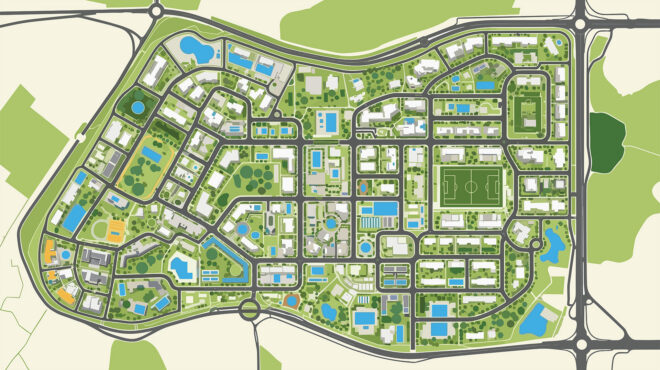
Purpose Built neighborhoods are designed with intention. Schools and families thrive in communities where design supports engagement, and where deep partnerships align housing, education, health, and economic opportunity. The result? Inclusive, stable neighborhoods that support economic diversity and upward mobility.
Mixed-income housing works best when it’s embedded within a larger ecosystem of opportunity, which is exactly what the Purpose Built model provides. For families who have experienced homelessness or housing insecurity, mixed-income neighborhoods aren’t just about affordable units. They’re about belonging. Through inclusive design, stable housing, and wraparound supports, we can create communities where every child has the chance to learn, grow, and succeed.
As we spotlight the issue of homelessness this November, we invite you to consider: what would it take to ensure every neighborhood in America is a place where all children can thrive? When we build strong, stable neighborhoods, we build a stronger, more equitable future for us all.