 Every Earth Day, the conversation around climate change tends to zoom out. We hear about global temperatures, rising sea levels, and sweeping solutions designed to meet a planetary-scale challenge. But climate change doesn’t show up in the abstract. It shows up in the neighborhoods where people live.
For Joe Fretwell, Vice President of Neighborhood Planning, and Ankita Chachra, Vice President of Prospects and Growth at Purpose Built Communities®, that’s where the conversation becomes real—and where solutions must begin.
Joe’s perspective is shaped by years of work at the intersection of housing, early childhood, and urban planning. Ankita brings a complementary lens, grounded in more than a decade of global experience working with cities and organizations to design public spaces and neighborhood strategies that support children and families. Together, their work reflects a shared belief: climate resilience is built at the neighborhood level, and it must center the everyday experiences of residents.
“The impacts of a changing climate and extreme weather events are often felt most acutely at the neighborhood scale,” Joe explains. Ankita sees this play out in how communities use and move through space. “When we think about resilience,” she adds, “it’s not just about infrastructure—it’s about whether families can safely access the places they rely on every day, even as conditions change.”
Climate Change, Up Close
The reality is that climate change is not experienced equally.
Neighborhoods that have faced long-standing barriers to investment are more likely to lack the infrastructure needed to adapt. As a result, climate challenges layer onto existing pressures, making it harder for families to navigate daily life. Research consistently shows that these conditions fall most heavily on communities impacted by concentrated poverty, and especially on children.
Joe has seen this firsthand in neighborhoods across the country, from Jacksonville to Atlanta to Baltimore. “Neighborhoods of concentrated poverty bear the brunt of the burden,” he says.
Children experience these impacts in ways that are often overlooked. Their bodies are still developing, which affects how they respond to heat and air quality. They breathe faster, process more of the air around them, and spend more time closer to the ground, where heat tends to concentrate.
“The World Health Organization estimates that children living today experience 90 percent of the disease burden from climate change globally,” Joe notes. “And a child born in 2025 is expected to experience roughly four times as many climate-related disasters over their lifetime as someone born a generation ago.”
For Ankita, these realities reinforce the importance of designing neighborhoods with families in mind from the outset. “If we understand how children experience their environments differently,” she says, “it pushes us to think more intentionally about how we design spaces that are safe, accessible, and supportive in a changing climate.”
Rethinking What Counts as Infrastructure
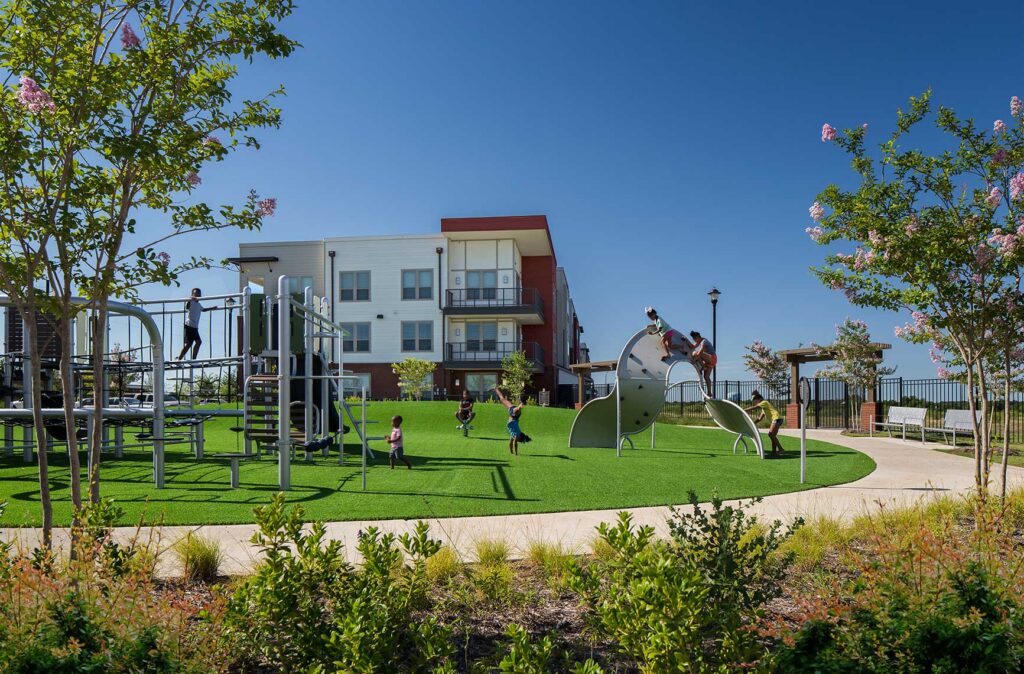
On Earth Day, green spaces often get a moment in the spotlight. But in neighborhood planning, they are far more than a finishing touch—they are essential.
“Elements like tree canopy, parks, and permeable surfaces aren’t amenities,” Joe notes. “They can actually be essential in managing stormwater and reducing the urban heat island effect.”
In neighborhoods with more tree cover and permeable surfaces, temperatures are lower, stormwater is better absorbed, and flooding risks are reduced. Studies show that shaded or grassy surfaces can be up to 45 degrees cooler than asphalt.
Ankita emphasizes that these spaces serve both environmental and social functions. “A well-designed public space can lower temperatures,” she explains, “but it also creates places where caregivers feel comfortable spending time, where children can safely play, and where community connections can grow.”
Those connections matter. Communities with strong social ties are better able to prepare for, respond to, and recover from disruption. The public realm plays a critical role in making those relationships possible.
Designing for Children Means Designing for Everyone
If climate resilience starts at the neighborhood level, where do you begin?
For Joe and Ankita, the answer is clear: start with children and families.
Joe points to the biological realities that make this approach essential, from developing sweat glands to smaller lungs and increased exposure to ground-level heat. What feels manageable for an adult can pose a real health risk for a child.
Ankita connects those realities to design decisions. “When we design for infants, toddlers, and caregivers, we set a high bar,” she says. “And when that bar is met, the result is a neighborhood that works better for everyone.”
This perspective reshapes how neighborhoods are built. It prioritizes safe, walkable streets, access to shade, and proximity to everyday needs like schools, grocery stores, and healthcare. It creates environments where families can move through their day with greater ease and stability, even as climate conditions become more unpredictable.
These are not small choices. They shape how people experience their neighborhood, how they connect with others, and how resilient a community can become over time.
The Hidden Ways Climate Change Shapes Daily Life
Not all climate impacts are dramatic, but they are deeply felt.
As extreme heat and severe weather increase, families have fewer opportunities to spend time outdoors. “This disruption affects not only daily life,” Joe says, “but also important moments of socialization that are essential for children and families.”
At the same time, longer allergy seasons, rising energy costs, and higher insurance premiums are quietly reshaping what it means to live in and afford a neighborhood.
“These pressures don’t exist in isolation,” Ankita adds. “They influence how families make decisions every day—where they go, how they spend time, and what feels accessible to them.”
Climate, Access, and Opportunity
Climate impacts also reveal a deeper truth: not all neighborhoods are equipped with the same resources to respond.
Communities with less tree cover, aging infrastructure, and limited access to essential services face greater exposure to heat, flooding, and poor air quality.
Joe suggests starting with simple but powerful questions: “Can a parent safely walk or bike with a young child to access daily necessities? If not, the neighborhood is falling short.”
Ankita sees this as an opportunity to design differently. “When we center the needs of those who face the greatest constraints—parents with young children, caregivers, older adults—we begin to create neighborhoods that are more inclusive, more resilient, and more connected.”
A Connected Approach to Climate Resilience
At Purpose Built Communities®, climate resilience is not treated as a standalone issue. It is part of a broader, integrated approach to neighborhood transformation that connects housing, education, community wellbeing, and economic vitality.
“A neighborhood where families are stably housed, where institutions are trusted, and where children and adults have access to opportunity,” Joe explains, “is a neighborhood with more capacity to prepare for, absorb, and recover from a climate event.”
This is where Community Quarterback Organizations play a critical role. These locally rooted organizations align partners, sustain long-term strategies, and ensure that investments reflect the needs and vision of residents.
Ankita notes that for communities exploring the Purpose Built model, this kind of alignment is essential from the start. “Resilience isn’t something you layer on later,” she says. “It’s something you build into the foundation—through partnership, planning, and a shared understanding of what a neighborhood needs to thrive.”
Resilience is not built through isolated efforts. It is built through coordination, trust, and time.
This Earth Day, Think Local
Earth Day reminds us of the scale of the climate challenge. But it also offers a chance to rethink where meaningful change begins.
Change is not just shaped by global commitments or national policy. It is shaped in neighborhoods.
“The good news is,” Joe says, “the future isn’t fixed.”
He points to the importance of imagination and collective action, echoing writer and activist bell hooks: “What we cannot imagine cannot come into being.”
Ankita shares that sense of possibility. “When we focus on the neighborhoods where people live their daily lives,” she says, “we’re not just responding to climate change—we’re shaping communities that are stronger, more connected, and better prepared for what comes next.”
When communities invest in green space, design with families in mind, and take an integrated approach to planning, they are doing more than adapting. They are building neighborhoods where resilience is part of everyday life.
And that work, grounded in place and driven by people, is where real change begins.